
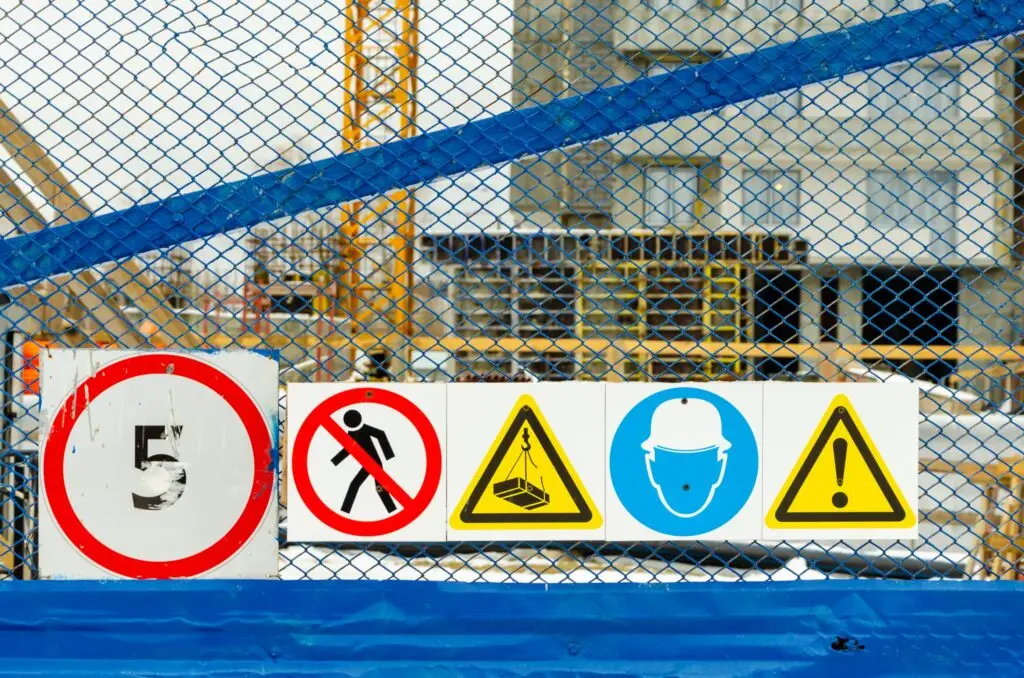
When it comes to corporate, business or workplace signage, many companies focus on branding, aesthetics or directional signs. That’s wise.
But one of the most critical uses of signage is often underestimated: health & safety signage. And, of course, the law means it’s imperative to have that around your premises or site.
In this article, we explain why safety signs matter so much, what laws in the UK require and how well-designed signage supports your safety culture and legal compliance.
What are the legal requirements for health & safety signage in UK workplaces?
Health and safety signs are very rarely optional. You can’t just ‘decide’ whether or not to have safety signage. In the vast majority of cases, you’re required. By law.
In the UK, the Health and Safety (Safety Signs and Signals) Regulations 1996 mandate that employers must provide safety signs anywhere there’s a significant risk that can’t be fully controlled by other means, such as engineering or training. The regulations also require that signs be clearly visible, adhere to national standards, be properly maintained and be in good condition.
These rules and regulations come from the UK’s implementation of European legislation, Directive 92/58/EEC to be precise, which sets minimum standards for workplace health & safety signage. Although, post-Brexit, the UK is no longer an EU member, these regulations and the core requirements of the directive remain in effect in the UK.
In practice, the vast majority of safety signage in the UK also follows BS EN ISO 7010:2019 (currently on its ninth amendment in 2025), the standard for graphical symbols and colours used on safety signs.
All organisations with any workers that could be at anyrisk have to comply with these laws, and while ISO 7010 standards are the go-to, the Health & Safety Executive (HSE) permits the use of alternative symbols (such as those meeting BS ISO 3864-1:2011 and BS ISO 3864-4:2011 standards) as long as they convey the same meaning and are easily understood. Failure to do so can result in fines and other enforcement action from the Government. Worse, your staff or visitors could be harmed.
The key takeaway here is that safety signage at your workplace isn’t optional. It’s a vital and legally required part of any responsible workplace.
Why safety signage matters on your worksite
Good safety signage plays a crucial role in preventing accidents, improving awareness and communicating vital information throughout your site. Some of the benefits include:
Alerting people to hazards and guiding behaviour
Safety signs are the same all around the country. That means everyone instantly knows what they mean (or at least has a good idea). Safety signage informs people about potential dangers and directs them on what to do or where to go (exit routes, first aid points, fire assembly points, etc.) if something happens.
Of course, follow-up and other training sessions are necessary too, especially for your workforce. You have to make sure they all know what all the signs mean, after all. That goes a long way in reducing your workplace accidents and keeping everyone safe.
Reinforcing a positive safety culture
Clear, professional health & safety signage tells everyone that your organisation takes safety seriously. People often look to corporations and expect them to take a lax attitude towards looking after their employees. But when you have all the relevant safety signs hung up, it’s just another thing that tells them you care.
Reducing liability and protecting your business
From a legal standpoint, effective workplace signage demonstrates due diligence. Having clear, visible safety signs is tangible proof that your company has taken steps to safeguard staff and visitors. That means you have far less exposure to liability if an accident does occur.
Best practices when implementing safety signage
To make your safety signage truly effective, you need to go beyond just ‘putting signs up’. Anyone can do that. Here are a few best practices to ensure your workplace signs serve their purpose:
- Conduct a risk assessment first – identify hazards and decide whether a sign is the best control measure. The law requires signage ‘where necessary’, that is, where risks can’t be eliminated by other means. If in doubt, it’s best to err on the side of caution and install a sign, even if you have other measures in place.
- Keep it clear and simple – use minimal text and clear symbols. Safety signs should be understood at a single glance. Besides, some of your employees, visitors or other stakeholders might not speak English well. Use text to provide additional details on top of the symbols of the signage in high-risk areas.
- Use appropriate size and placement – your signs should be visible from the required distance. As a rough guide, use about 15mm of letter height per metre of viewing distance. Mount them at eye level on walls and doors. Make sure nothing obscures them.
- Choose durable materials – your signs must be made of materials suitable for your environment. For instance, weather-resistant aluminium for outdoor use, or vinyl for indoor applications.
- Maintain consistency – keep all your corporate signage (including safety signs) consistent in style, layout, tone and placement. This will help your employees recognise them.
- Provide training – a sign is effective only if people understand what it means. Include safety sign recognition in employee inductions and regular top-up health and safety sessions.
- Audit and update – review your safety signage once per year or whenever your operations change. Remove any outdated signs and ensure all essential ones are still visible and relevant.
How safety signage fits into your broader strategy
While health & safety signage has strict regulatory standards, it should still integrate into your wider corporate signage strategy.
Your brand image extends to every part of your workspace, and that can include your safety signage, as long as you don’t obstruct any part of the sign’s message, of course. With careful design, your signs can align with your brand without compromising compliance or visibility.
In particular, consider combining wayfinding signage with safety signage. That way, your employees and visitors can navigate safely around your premises, rather than having to find directions and pick up safety hints along the way.
Ask PB Signs to help design your safety signs
Health & safety signage is a legal requirement. But, as discussed on this page, it’s also so much more.
If you’re unsure where to start or want to ensure your signage meets current regulations, PB Signs is here to help. We design, print and install compliant safety signage for organisations all around the country, going to great lengths to ensure it both keeps your workplace safe and complements your brand.
For more information about our quick turnaround times and wide range of available materials, please don’t hesitate to get in touch. We’d be delighted to have an obligation-free chat about your needs and what PB Signs can do for you.