AI has completely changed the way people approach design.
You can describe an idea, upload a photo or type a few prompts and, within seconds, generate a logo, sign concept, exhibition stand, vehicle wrap or wall graphic that would once have taken hours to visualise.
And that’s genuinely useful.
At PB Signs, we’re not anti-AI. Used well, it can be a brilliant tool for exploring ideas, developing concepts and helping clients show us what they have in mind.
But there’s an important distinction between an AI-generated design and professional, print-ready artwork.
And it’s something we’re seeing more and more.
AI Is Brilliant at Showing Us What You’re Thinking
One of the biggest advantages of AI is that you don’t need to know the language of design to communicate an idea.
You might not know how to explain the exact style of exhibition stand you want, but you can generate an image that gets surprisingly close. You can experiment with colours, layouts and styles before you’ve spent anything on design or production.
From our point of view, that’s useful too.
If you send us an AI-generated visual and say, “This is roughly what I’m imagining,” it gives our designers a fantastic starting point.
The problem comes when that starting point is treated as the finished artwork.
Looking Good on Screen Isn’t the Same as Being Print-Ready
An AI-generated image might look fantastic on your phone or laptop, but try enlarging it to cover a 4-metre exhibition wall, shop fascia or vehicle and things can quickly start to fall apart.
Professional signage and large-format print require artwork to be created at the correct size, resolution and specification.
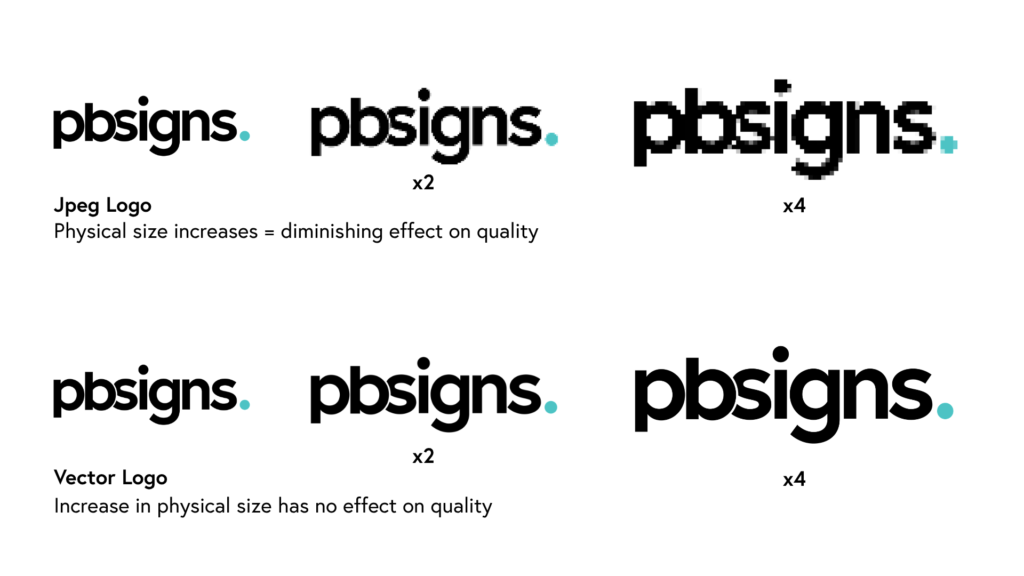
Logos and other graphic elements will often need to be supplied or recreated as vector artwork.
Unlike a standard JPG or PNG, vector artwork isn’t made from a fixed grid of pixels. It can be enlarged from a business card to the side of a building without becoming pixelated or losing its sharpness.
AI can create the appearance of a logo, but that doesn’t necessarily mean you’ve got a usable logo file.
That’s a big difference.
Your Brand Is More Than a Prompt
A limitation that’s harder to measure: personality.
AI is exceptionally good at producing things that look like good design. But that doesn’t necessarily mean the result feels like your business.
A designer can understand your existing branding, your customers, your industry, your tone of voice and what you’re actually trying to achieve.
Sometimes that means questioning the original idea.
Maybe the logo needs to be bigger. Maybe there’s too much information. Maybe the colour combination won’t have enough contrast from across the road. Maybe the concept looks impressive in isolation but doesn’t fit with the rest of your brand.
AI gives you what you ask for.
A good designer should also be able to tell you when there’s a better way to do it.
There Are Details AI Still Gets Wrong
We’ve all seen them: strange lettering, almost-correct logos, nonsensical words and tiny details that look convincing until you zoom in.
That’s less of a problem when you’re generating an image for inspiration.
It’s a very big problem when you’re printing it several metres wide.
Brand colours also need consideration. The colour you see in an AI-generated RGB image on a backlit screen isn’t necessarily the colour that will come out of a large-format printer.
For professional print and signage, we need to consider things like CMYK values, Pantone references, resolution, bleed, cut paths and production tolerances.
They’re not particularly exciting parts of the design process – but they’re often the difference between a nice visual and something we can actually manufacture.
So Should You Use AI for Your Signage Ideas?
Absolutely.
Use it to experiment. Use it for inspiration. Use it to visualise an idea that’s difficult to explain. Send us the images you’ve generated and show us the direction you like.
Just don’t worry if the file you’ve created isn’t suitable for printing.
That’s where we come in.
Our design team can take the idea behind an AI-generated concept and turn it into professional artwork that’s correctly sized, properly vectored where required, brand accurate and – most importantly – designed around how the finished product will actually be manufactured and installed.
AI can be a brilliant way to start the conversation.
But there’s still quite a journey between a great prompt and a great sign.